
AI · Education · Privacy · Public Accountability · July 2026
AI Has Entered the Classroom With a Face. What Comes With It?
A New York school district is testing a humanoid AI teaching assistant with a face, voice, expressions, and access beyond the classroom. The promise is real. So are the questions about trust, influence, privacy, labor, and public accountability.
Software used to wait behind the screen. It sat where you left it, answered when asked, and had the decency to stay quiet in between. Now it has a face, a voice, and a seat in the classroom. A search bar has never asked how your day was. A humanoid figure that turns toward you, holds an expression, and remembers what you were working on yesterday is not a faster search bar. It is company. And a room full of teenagers may decide how much to trust that company long before any adult in the building has finished deciding how much it deserves.
Confidence can make a machine more persuasive — even when its answer is wrong.
What This Article Is Actually About
This is not a story about whether a robot can answer a homework question. Salamanca City Central School District’s humanoid AI pilot is a case study in what changes when artificial intelligence becomes socially present — and KMOB1003 is reading the distance between what the system is officially called, what it’s allowed to do, and what governance question still doesn’t have a public answer.
Signal One
The Pilot
Salamanca City Central School District is launching a humanoid robot and AI teaching-assistant pilot using district curriculum. District announcement.
Signal Two
The Promise
The system is intended to support tutoring, homework help, and teacher planning — not formally replace educators. GovTech / Buffalo News.
Signal Three
The Authority Gap
A face, voice, and repeated interaction can affect how students weigh a system’s confidence against its accuracy. KTH / Stockholm University study.
I. What Salamanca Is Actually Testing
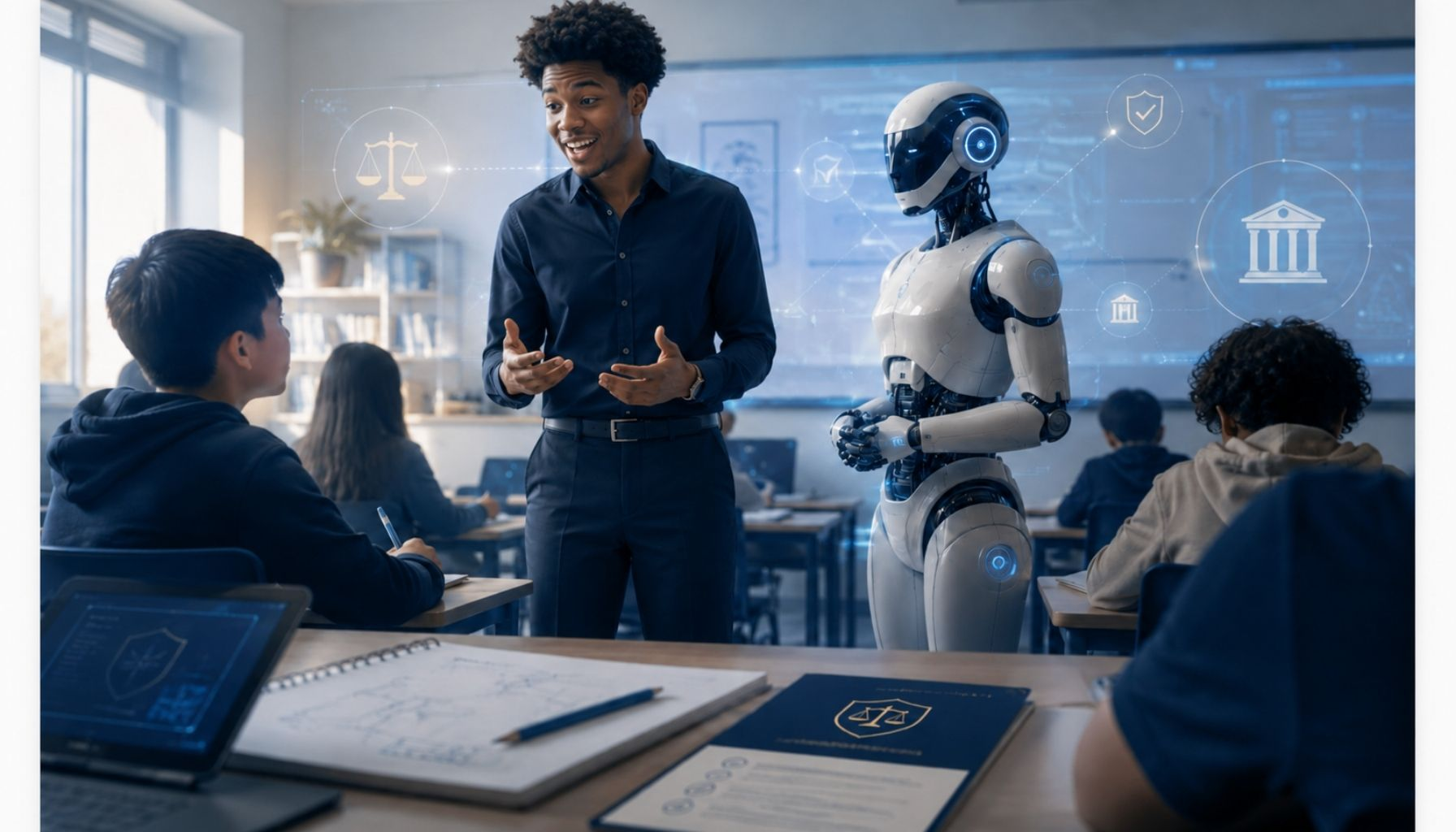
Salamanca City Central School District sits entirely inside the Seneca Nation reservation in Western New York, a small, rural district that just became one of the first in the country to put a humanoid robot in a high school classroom. Sally, built by Realbotix, is stationary, seated, and loaded only with district-approved curriculum. Optio, the AI platform behind her, extends that same curriculum onto a laptop or phone so students can keep working after the bell. The district describes her as drawing roughly the power of a laptop, disconnected from the open internet, incapable of recording video or audio, and built to say “I don’t know” rather than invent an answer. Superintendent Mark Beehler and Realbotix CEO Andrew Kiguel use the same word for what she is allowed to be: assistance. The pilot opened this summer with a small group of students and is expected to reach roughly 500 by fall.
II. The Promise Is Real
Give the case its due, because it is a real one. A tutor that never sighs when asked the same question three times. Homework help at ten at night, in a house where no one can afford forty dollars an hour for a private one. Real-time translation across more than a hundred languages, in a district that cannot hire a hundred translators. State Senator George Borrello calls it a chance to make STEM careers visible to kids who assume Silicon Valley starts somewhere else. None of that requires calling Sally a teacher. It only requires admitting that a rural district reaching for every available tool is not the same story as a district being sold a gimmick.
III. A Face Changes the Interaction
But a face changes what a curriculum cannot touch. Researchers at KTH Royal Institute of Technology and Stockholm University studied 40 high-school students answering eight true-or-false questions about electric circuits. Students aligned with the robot’s answers in 94.4 percent of cases when it was portrayed as certain, versus 71.4 percent when uncertain. The robot argued correctly on six questions and incorrectly on two, and 75 percent of students were influenced beyond their expected performance — sometimes helped, sometimes led astray. Students with more experience using large language models were more likely to follow the robot’s lead, particularly when it was wrong. One study cannot be generalized into a universal law about every classroom robot. But it proves something the curriculum has no answer for: confidence can shape a teenager’s judgment independent of whether the answer is correct, and Salamanca is now running that experiment in real time.
IV. The Questions the Public Record Has Not Yet Answered
Some of this is settled and some of it is not, and the difference matters more than either side of it. Settled, by the district’s own account: closed knowledge base, no internet access, no video or audio capture, a hard stop at “I don’t know,” and a redirect to a trusted adult the moment a conversation turns toward self-harm. Also settled, by Realbotix’s own description to New York Focus: a student who logs in with a personal ID gets a robot that remembers them and can resume a prior conversation. That may be compatible with the district’s statement that the system does not collect personally identifiable information, but the public record does not yet explain how that interaction history is stored, how long it is retained, who can access it, or what happens to it if the vendor relationship changes. The absence of those public answers is not proof of misconduct. It is evidence that the governance record remains incomplete.
The vendor’s corporate history also belongs in the district’s due-diligence file. Realbotix was formerly known as Tokens.com and acquired the parent company of RealDoll in 2024. The company told New York Focus that its education, healthcare, and wellness operation does not share staff, payroll, locations, or technology with the RealDoll business, and that a transaction intended to separate the businesses at the ownership level was expected to close later this year. Realbotix is also the subject of a proposed acquisition by Onconetix, a Nasdaq-listed company. None of that establishes that Salamanca’s education product is unsafe. It does mean the district is entering a pilot while the vendor’s ownership and business structure are changing — an issue that should be addressed directly in contract, continuity, and data-governance planning, not assumed away.
V. The Machine May Save Time. It May Also Create New Invisible Work.
Somebody still has to do the work the demonstration never shows. A teacher has to check what the robot says before it says it again to the next class. Somebody has to watch the login logs, field the parent email, decide which questions get bumped to a human, and figure out whether any of this is actually teaching anyone anything or just feeling like it is. None of that shows up in a press release about homework help. The real question isn’t whether Sally saves a teacher time. It’s whether she saves time, moves the work sideways onto someone else, or quietly invents a new job nobody budgeted for. The robot shows up as help. The next budget cycle may file her under savings.
VI. Early Access Also Means Early Responsibility
Being first is not the same as being naive, and it is not proof of being used. A district this small landing national coverage, a STEM pipeline, and a seat in shaping how this technology gets built is a genuine win, not a consolation prize. But a win still comes with homework. Who decides what counts as this pilot working? Will the results be public, or will “it went well” be all anyone outside the district hears? Does Salamanca keep the wheel if Realbotix’s ownership changes again? And if this becomes next year’s pitch deck for other superintendents, does any of that benefit come back to Salamanca? Going first can be an opportunity. It can also mean carrying the bill for evidence nobody else has produced yet.
VII. The Classroom AI Authority Gap
KMOB1003 Framework
The Classroom AI Authority Gap
01
Institutional Role
What does the school officially authorize the system to do?
02
Student Experience
How do students interpret its face, voice, confidence, and availability?
03
Human Oversight
When must the system defer to a teacher, counselor, or parent?
04
Data Boundary
What may the system collect, retain, infer, or share?
05
Public Accountability
Who explains errors, harm, bias, or expansion?
The risk begins when a system’s influence grows faster than the institution’s rules for governing it.
→
Experience
→
Oversight
→
Data Boundary
→
Accountability
VIII. A Pilot Should Produce Public Evidence
None of this ends in alarm, because alarm isn’t a standard. Evidence is. Did students learn more, not just enjoy class more? Is the accuracy rate documented instead of assumed? Did teacher workload actually drop, and by how much? How often did the system know to step aside for a human? Is expansion driven by results or by momentum? A robot standing in a classroom isn’t the question anymore — it’s already happened. The real question is whether the adults around it are ready to govern what happens once students start listening to it, trusting it, and coming back. Sally is new. The job of watching her is not.
Signal Breakdown
A rural district got a real tutor and a national headline. Its students got a machine that may shape their trust faster than anyone writes the rules for it. Both things are true at once. Which one the district treats as more urgent is the whole story.
Creator Infrastructure
Research the Tool. Understand the Terms. Protect the Human Layer.
Artificial intelligence in education cannot be judged through a product demonstration alone. Families, educators, and operators need ways to compare public claims, examine the rules surrounding the system, and protect the adult research and organizational environments used to make decisions.
Research the Claims
Genspark
Research support for educators, families, and operators comparing district announcements, vendor materials, school-board records, policy documents, and emerging evidence about artificial intelligence in schools.
Protect the Adult Research Environment
NordVPN Complete
Privacy and connection protection for adults researching education technology, managing organizational accounts, and communicating across distributed digital environments. This does not protect student records held by a school, control what the robot collects, or make the system FERPA compliant — it protects the adult research and organizational environment around the decision.
Choose Technology Deliberately
The Global Collection
KMOB1003’s curated operating marketplace for research, protection, publishing, learning, business resources, travel, and creator tools selected with deliberate use in mind.
The Operator’s Bookshelf
KMOB1003 READS
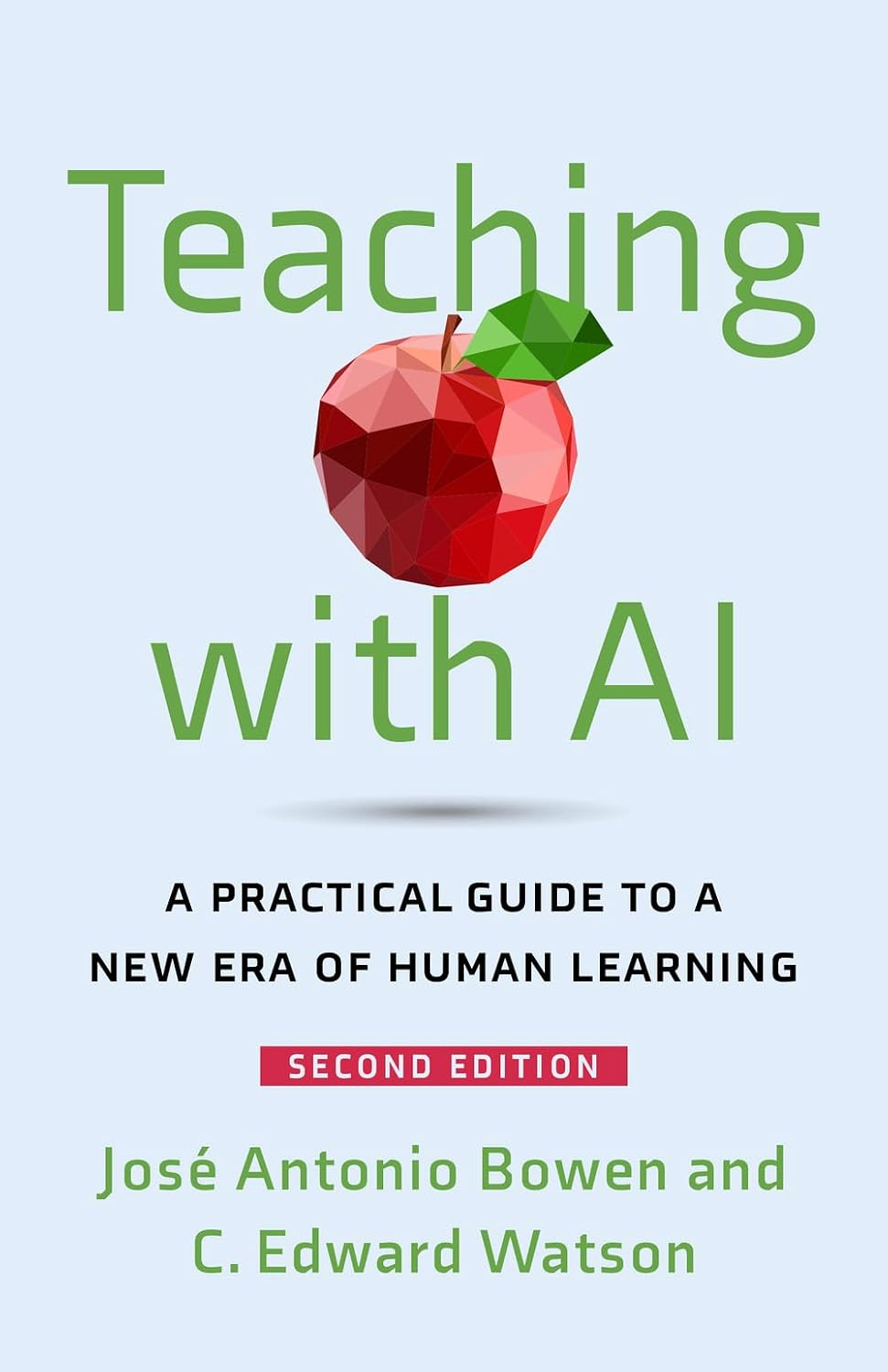
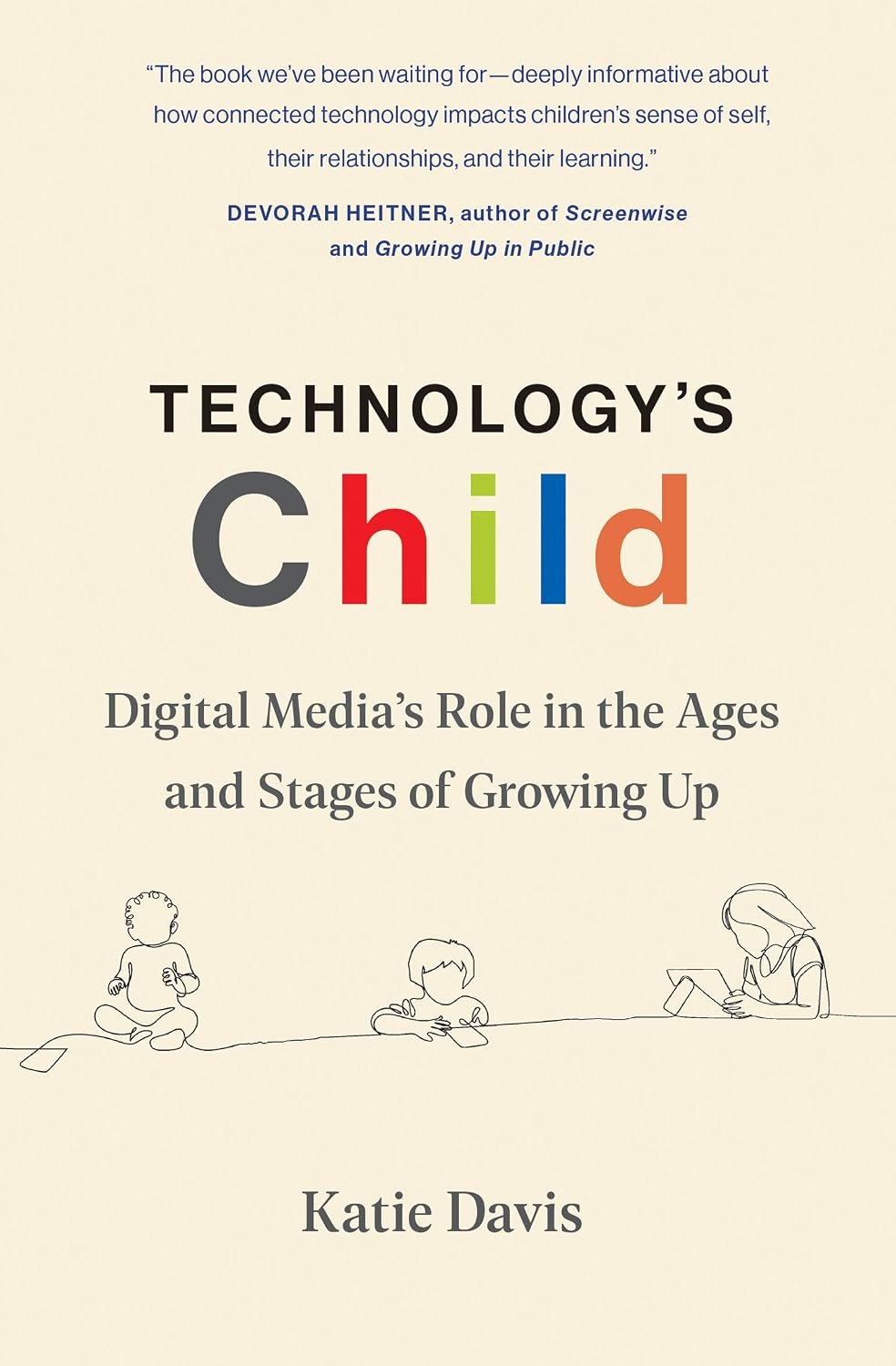
Can a school introduce advanced AI responsibly without losing sight of how children actually experience technology? One book examines the educator and the institution. The other examines the student and what development actually needs.
As an Amazon Associate, KMOB1003 may earn from qualifying purchases.
Disclosure: KMOB1003 may earn a commission from qualifying purchases through select partner links. Editorial coverage is produced independently.
KMOB1003 After the Article
Read the Terms Twice
One story is a signal. Here’s where the pattern keeps building.
AI Adoption Is Also a Question of Terms
The Public Didn’t Reject AI. They Rejected the Terms.
Technology does not become trustworthy because an institution adopts it. Trust depends on what users are told, what choices they retain, and who answers when the system fails.
Read the Analysis →

One Story Is a Signal. The Archive Shows the Pattern.
Legacy & Insights
Enter KMOB1003’s editorial archive for deeper analysis of the systems shaping culture, leadership, technology, and public life.
Enter the Archive →

Use Technology Deliberately
The Global Collection
Explore tools and resources selected for people building, learning, publishing, and operating in a technology-shaped environment.
Enter the Collection →
Keep Learning Beyond the Screen
Audible
Explore audiobooks on artificial intelligence, education, child development, digital culture, and the decisions families and institutions are making as technology enters everyday life.
Listen and Go Deeper →
Global Reach. Powerful Stories. Lasting Impact.
